
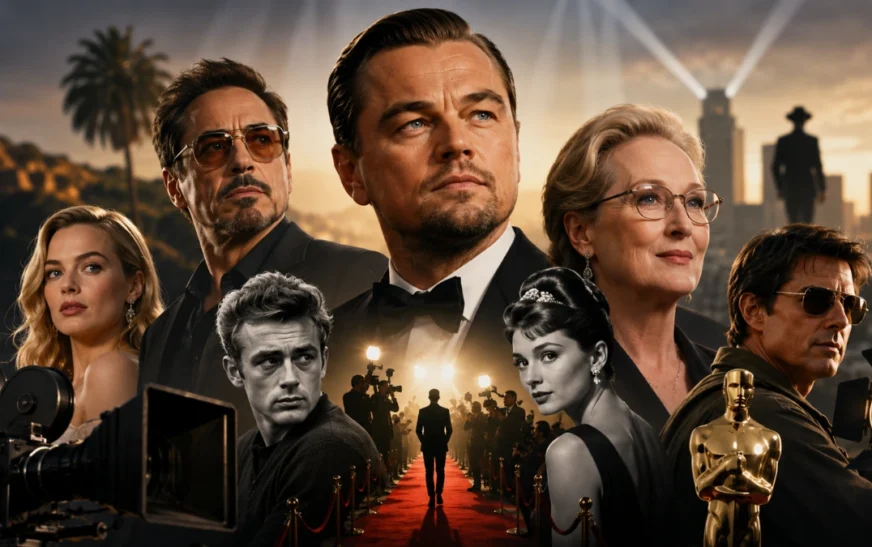
There is something special about watching a great actor on screen. A strong performance can stay in your mind for years. Sometimes it is not even the full movie you remember first. It is the face, the voice, the emotion, or one small scene that felt completely real. That is a big reason Hollywood actors continue to fascinate people all over the world.
This guide books at how Hollywood acting has changed over time, from the silent film era to today’s streaming age. We will go through the early stars, the studio years, the rise of method acting, the blockbuster period, and the modern entertainment business. If you enjoy movies even a little, this is such a fun topic to explore!
Think about it for a second. Have you ever watched an old black-and-white film and then switched right after to a new series on Netflix or a recent big-screen hit? The difference is huge. Acting styles, movie trends, and even the way stars are presented have all changed. But one thing has stayed the same: when the acting is good, the story feels alive.
The Pioneers of Cinema
Long before Hollywood became the center of the film world, screen acting was still being invented. In the silent movie era, performers could not depend on spoken lines. They had to tell the story with expression, movement, posture, and timing. That sounds simple, but it took a lot of skill.
Some of the earliest stars helped create the rules of film performance. Charlie Chaplin, Buster Keaton, Mary Pickford, and Douglas Fairbanks were more than famous faces. They showed audiences what screen charm looked like and what emotional storytelling could feel like without dialogue.
Chaplin is one of the clearest examples. He could be playful, awkward, sweet, and heartbreaking all in the same film. That mix made his work unforgettable. Mary Pickford also had a huge influence. She was not only a beloved actress, but also a smart business figure who helped shape the industry itself.
These early Hollywood actors were among the first global celebrities. People followed their work closely, and studios learned very quickly that actors could draw huge audiences. This was the beginning of movie stardom as we know it.
The silent era also taught an important lesson: film acting is not the same as stage acting. On stage, performers often need bigger movements and louder energy. On camera, even a small glance can mean everything. That idea still matters today.
The Golden Age of Hollywood
When people picture classic movie stardom, they often think of the Golden Age of Hollywood. This period, stretching roughly from the 1920s to the 1950s, gave the world some of its most iconic actors and actresses. It was also the time when large studios had enormous power.
Studios such as MGM, Paramount, Warner Bros., and 20th Century Fox managed almost every part of a star’s career. They signed actors to contracts, selected roles, shaped public images, and sometimes even changed names or personal backgrounds to make stars easier to market.
That system produced many legendary names. Humphrey Bogart had a tough but emotional style. Katharine Hepburn brought confidence and intelligence to the screen. Cary Grant was smooth, funny, and deeply charming. Bette Davis had unmatched fire, and James Stewart made sincerity feel powerful.
The acting style in this era often seemed polished and controlled. Speech was clear, body language was careful, and many stars carried themselves with elegance. But that does not mean the performances were cold. Not at all! Watch films like Casablanca, All About Eve, or Roman Holiday, and you will see actors with real presence and precision.
This was also the period when certain actors became strongly tied to certain genres. Some were known for noir. Others became kings of westerns, musicals, romances, or historical dramas. Audiences loved that connection because it gave stars a clear identity.
The Rise of Method Acting
By the 1950s and 1960s, acting in Hollywood started to change in a noticeable way. Performances became less formal and more emotionally raw. This shift was strongly connected to method acting, which grew from ideas linked to Konstantin Stanislavski and was later developed in the United States by teachers like Lee Strasberg and Stella Adler.
Method acting pushed performers to go deeper into a character’s inner life. Instead of simply saying the lines well, actors tried to understand what the character felt, feared, wanted, and remembered. The goal was truth, not polish.
Marlon Brando became one of the best-known symbols of this change. His work in A Streetcar Named Desire and On the Waterfront felt intense and unpredictable. He did not seem arranged or carefully posed. He felt real. James Dean carried a similar energy, especially in roles that showed rebellion, pain, and emotional conflict.
Later, actors like Al Pacino, Robert De Niro, Dustin Hoffman, and Ellen Burstyn helped push this approach even further. Their performances often felt deeply lived-in. A pause mattered. A whisper mattered. Even silence could carry weight.
Method acting did not completely replace older styles, but it changed what many viewers expected from a performance. People began to respond more strongly to acting that looked natural and emotionally honest.
The New Hollywood Era
In the late 1960s and throughout the 1970s, the film industry entered a new chapter. The old studio system had less control, and a younger generation of filmmakers and performers began reshaping American cinema. This period is often called New Hollywood.
Movies from this era often felt bolder and more realistic. They dealt with politics, social tension, personal struggle, and moral uncertainty. Characters were not always clean-cut heroes. In fact, many were messy, flawed, or hard to understand—and that made them interesting.
Actors played a huge part in this shift. Jack Nicholson, Diane Keaton, Gene Hackman, and Faye Dunaway became major figures during this time. Their performances felt modern, sharp, and less artificial than some of the heavily managed screen personas of the past.
What made this period exciting was the freedom. Actors were allowed to explore more layered characters. Stories could be strange, dark, funny, or unsettling. A lead performance no longer had to fit one perfect star image.
This era also helped strengthen collaboration between actors and directors. Many films were driven as much by character as by plot, which gave performers more room to shape a role in personal ways.
Blockbusters and Global Stardom
By the late 1970s and into the 1980s, another major change arrived. Big event movies started taking over the box office. Action films, adventure stories, and large commercial releases became more important, and actors found themselves at the center of global entertainment.
This was the age of stars like Harrison Ford, Tom Cruise, Arnold Schwarzenegger, Sigourney Weaver, Eddie Murphy, and Meryl Streep. They showed just how wide the idea of stardom had become. Some dominated action. Others were known for comedy or serious drama. A few could do almost anything.
Harrison Ford brought a grounded quality to huge roles like Indiana Jones and Han Solo. Tom Cruise built a career on energy, charm, and commitment. Meryl Streep earned praise again and again for range, detail, and emotional control. Each of them represented a different kind of success.
This was also the period when actors became truly international stars. Their films were no longer made only for American audiences. The global box office grew more important, and that affected casting decisions, salaries, and publicity.
As movies earned more money, top Hollywood actors gained more bargaining power. Paychecks rose, and backend deals became a major part of contracts for major stars.
The 1990s and 2000s: Prestige, Range, and Franchises
The 1990s and early 2000s were packed with variety. Big studio films were thriving, but so were independent movies, prestige dramas, and huge franchises. For actors, that meant more than one route to success.
This was a key period for performers such as Denzel Washington, Julia Roberts, Leonardo DiCaprio, Sandra Bullock, Brad Pitt, Nicole Kidman, and Johnny Depp. Many moved comfortably between crowd-pleasing hits and more serious roles.
Leonardo DiCaprio is a strong example of how a career could develop in this era. He started as a rising young actor, became a worldwide star after Titanic, and then kept choosing ambitious roles that built long-term respect. Denzel Washington also stood out, bringing intelligence, calm strength, and emotional control to role after role.
At the same time, franchise films became more powerful than ever. Series like Harry Potter, The Lord of the Rings, Spider-Man, and later the Marvel films changed the business. An actor was no longer just joining a movie. They were sometimes joining a world that could continue for years.
That changed the relationship between stars and studios. Long-term contracts became more common, and audiences began connecting actors very strongly with specific characters.
Today’s Highest-Paid Stars
Today, top actors often earn money in several different ways. A base salary is only one part of the picture. Some also receive producer fees, bonus payments, brand deals, ownership income, or a share of profits.
Depending on the year, names like Tom Cruise, Dwayne Johnson, Ryan Reynolds, Margot Robbie, Adam Sandler, Jennifer Aniston, and Leonardo DiCaprio often come up in conversations about high earnings. Exact rankings change because every deal is different.
Tom Cruise is often mentioned because of the reported success of his Top Gun: Maverick earnings. A smart contract tied to performance can turn one film into an enormous payday. On the streaming side, stars may receive a very large amount up front because there is no normal box office percentage.
Still, money is not the only thing shaping careers. Many respected actors take on smaller projects because they want better scripts, stronger characters, or the chance to try something new. That balance between business and craft is still a huge part of Hollywood.
Streaming Changed the Game
Streaming has changed the acting world in a big way. Services like Netflix, Disney+, Apple TV+, Hulu, Max, and Amazon have created new kinds of opportunities for both established stars and rising talent.
Years ago, some movie actors saw television as a step down. That thinking has faded. Now it is common to see major Hollywood actors move between films, limited series, voice roles, and streaming originals without hurting their careers.
In many ways, streaming has made room for richer character work. A film may last two hours, but a series can give an actor several episodes to slowly build a role. That extra time can lead to performances that feel more detailed and layered.
Of course, the rise of streaming has also made the industry more competitive. Film, TV, and digital content now overlap all the time. Actors are expected to be flexible, visible, and ready for a fast-changing market.
Diversity, Inclusion, and New Voices
Another major change in recent years has been the growing demand for better representation on screen. Hollywood still has progress to make, but there has been a clear push toward wider inclusion and stronger support for new voices.
More performers from different racial, cultural, and national backgrounds are leading major projects. Actors like Viola Davis, Michael B. Jordan, Zendaya, Steven Yeun, Florence Pugh, Pedro Pascal, and Simu Liu reflect a broader and more modern version of Hollywood.
This matters not only because of fairness, but also because it improves storytelling. Audiences want stories that feel fresh and honest. They want characters who reflect real life and perspectives that may not have been centered in older films.
Casting discussions, award conversations, and studio decisions now face closer public attention. People care more about who gets opportunity, who gets recognition, and whose stories are being told.
What Makes a Great Hollywood Actor?
This is such an interesting question because there is no single answer. Great acting can look very different from one person to another. Still, a few qualities appear again and again.
A great actor has presence. Even when they say very little, you notice them. They know how to listen in a scene, how to respond naturally, and how to make a line sound true instead of performed. They create the feeling that the character existed before the movie started and will keep existing after it ends.
Range is important too, though it works in different ways. Some actors completely disappear into each role. Others stay closer to their own style but bring so much depth that every performance feels unique.
Discipline also matters a lot. Many actors spend years training, studying scripts, learning accents, changing body language, and working carefully with directors. Great acting may look easy, but it almost never is.
And then there is star power. It is hard to define, but everyone recognizes it when they see it. Some people simply have that pull.
The Business Side of Acting Careers
From the outside, acting can look glamorous and effortless. The truth is usually very different. Most careers are built slowly, with lots of rejection, small roles, side jobs, and uncertain moments along the way.
Actors often work with agents, managers, lawyers, and publicists. Many also launch production companies so they can help create projects instead of only waiting for offers. That business side has become more important over time.
Career growth usually depends on several things:
Training and craft
Training can happen in many ways. Some actors attend drama school. Others learn through theater, workshops, private coaching, or direct set experience. What matters most is continued improvement.
Networking and visibility
Relationships can open doors. Casting directors, filmmakers, producers, and fellow actors often help shape a career through trust and repeated collaboration.
Smart role choices
One good role can change everything. On the other hand, poor choices can limit momentum. Picking projects carefully matters more than many people realize.
Adaptability
The industry keeps shifting. Actors who can move between genres and formats often stay active for longer periods.
The Current State of Hollywood Acting
Right now, Hollywood is going through another period of change. Streaming is still important, but studios are rethinking spending, release strategies, and the future of big franchises. The effects of labor disputes, higher production costs, and changing audience habits are still being felt.
There is also more global competition than ever before. A breakout actor might come from a major studio film, but they might also rise through an international streaming series. That has made the field wider and more open.
Technology is another big issue. Conversations around artificial intelligence, digital likeness rights, and performance capture are becoming more serious. Actors and unions are paying close attention to how these tools might affect jobs, contracts, and creative control.
Even with all these shifts, one truth remains easy to see: audiences still respond to honest performances. Trends may come and go, but real emotion still works.
Conclusion
Hollywood acting has changed a lot over the years. It began with silent performers using expression and movement, grew through the studio era, became more emotionally intense with method acting, and expanded into a global business shaped by streaming and franchises.
Learning about Hollywood actors can make watching movies even more enjoyable. You start to notice the craft behind a scene, the history behind a performance, and the choices behind a career. That makes the whole experience richer.
And honestly, that is part of the fun! Movies are not only about stories. They are also about the people who bring those stories to life. As the industry keeps changing, new stars will rise and new styles will appear, but great acting will always matter.
FAQs About Hollywood Actors
How do most Hollywood actors start their careers?
Most begin with small steps. They might take acting classes, audition for commercials, appear in student films, join local theater, or land tiny parts in TV shows. Very few people become stars overnight.
Do Hollywood actors still need acting school?
Not always, but training helps a lot. Some actors go to drama school, while others learn through workshops, theater work, and real on-set experience. Skill grows through practice.
Who are considered some of the greatest Hollywood actors of all time?
That list often includes names like Marlon Brando, Meryl Streep, Denzel Washington, Katharine Hepburn, Robert De Niro, Al Pacino, Ingrid Bergman, Jack Nicholson, Daniel Day-Lewis, and Bette Davis.
What is method acting?
Method acting is a style where actors try to connect deeply with a character’s inner world. They may use memory, emotional focus, and detailed preparation to make the role feel real.
Who are the highest-paid Hollywood actors today?
The names change often, but stars like Tom Cruise, Dwayne Johnson, Ryan Reynolds, Adam Sandler, and Leonardo DiCaprio are often mentioned among the top earners.
How much do famous actors make per movie?
It depends on the actor and the project. Some earn a few million dollars, while major stars can earn over $20 million up front. Profit-sharing can increase that amount even more.
Are streaming actors paid differently than movie actors?
Yes, sometimes they are. Traditional movies may include box office bonuses, while streaming projects often offer bigger up-front deals. Contracts vary a lot.
Do actors earn money after a movie is released?
Yes. Some actors receive residuals or profit payments after release, depending on their contracts and the kind of project involved.
What makes a performance legendary?
Usually it is a mix of strong writing, emotional honesty, memorable scenes, timing, and long-term cultural impact. People keep talking about it years later.
Which performances are often called legendary?
Common examples include Marlon Brando in The Godfather, Vivien Leigh in Gone with the Wind, Anthony Hopkins in The Silence of the Lambs, Meryl Streep in Sophie’s Choice, Denzel Washington in Training Day, and Heath Ledger in The Dark Knight.
Is it harder to become a Hollywood actor now?
In some ways, yes, because competition is intense. But there are also more paths than before, including streaming, indie films, online content, and global productions.
Can actors move between film and television easily today?
Yes. This is much more normal now. Many major stars move between movies, TV series, voice roles, and streaming projects without any problem.
Are Hollywood actors involved in producing now?
Very often. Many actors produce projects so they can have more creative control and build stronger careers beyond acting alone.
What is the future of Hollywood acting?
The future will likely include more streaming work, more international casting, more technology in production, and continued debate around AI and digital rights. But strong human performances will still be at the center of great storytelling.